


ANOTHER CHANCE TO HAVE YOUR SAY - THIS TIME ON BEHALF OF KOALAS
The NSW Government has released their superficial and simplistic Koala Strategy for public comment by 9 November. We need to let the Government know its just not good enough. NEFA's submission guide is here. Please help those that can't help themselves.
A PLAN TO END LOGGING OF PUBLIC FORESTS AND PROTECT NORTH EAST FOREST PARKS
SEE THIS SLIDESHOW OF WHY IT'S TIME TO STOP THE LOGGING
NEFA's proposal to Protect North East Forest Parks covers all 573,568 ha of public native forests (excluding the Great Koala National Park) north from the Hunter River (at Newcastle) to the Queensland border, from the coast west to the New England Highway on the Tablelands. It will enhance and link together existing reserves to create a 2.2 million ha world class reserve system over one of the world’s centres of biodiversity. It is home to 241 threatened species, most records by far are for Koalas, with abundant Greater Gliders, Yellow-bellied Glider and South-eastern Glossy-black Cockatoos, along with the predatory Spotted-tailed Quoll, Powerful Owl, Sooty Owl and Masked Owl utilising decling tree hollows in the Great Escarpment forests. The coastal forests are searched for declining nectar by Critically Endangered Swift Parrots and Regent Honeyeaters, along with Grey-headed Flying-fox and Little Lorikeet. So many plants are endemics found in limited areas and nowhere else on earth.
Back in 1998 the NSW agencies applied the national reserve criteria to identify most State Forests were needed to establish a Comprehensive, Adequate and Representative reserve system, including 57% of these State Forests. So the Government put a timber limit on what could be protected. Ever since they have stopped a reassessment, until now. The State and Federal Governments are doing a new regional assessment for when the exemption from the EPBC Act expires on 1 July 1997 - they have no intent to review the reserve system, but we do. At the same time the Governments are working out how to meet their commitments to protect 30% of the land by 2030 (30by30). NSW has only 10% protected, and the Federal Government has identified all forests in north-east NSW as being the highest priority in Australia for protection, so it should be an easy choice. But when it comes to logging it never is.
We need your help to convince them to do the right thing. Now that the Government can get carbon credits for protecting forests, they have a funded pathway, and no excuses.
We want a commitment to protect the North East Forest Parks before the March election.
The North East Forest Parks are comprised of 17 groups of forests, including the Richmond River Koala Parks. We are hoping people will adopt other areas for similar campaigns, and that we can work together to protect the lot. We don’t have long. For a start we need to collate good images of what we are trying to save, so let us know if you have some.
USING CARBON CREDITS TO SAVE FORESTS
The Federal Government has adopted the Improved Native Forest Method (INFM) that allows governments to earn carbon credits for 15 years if they end logging of public native forests and protect them for 100 years. The National Party lodged a disallowance motion for the INFM, describing it as a death knell for the native timber industry. The timber industry, along with some conservation groups, called on the Greens to support the disallowance. After a divisive, and at times nasty, debate within the environment movement, the majority of the Greens did not support the disallowance.
Now the NSW Government is going to proceed with creating the Great Koala National Park, an historic decision to protect 176,000 ha of habitat for Koalas, Greater Gliders and 100 other threatened species in one of our most important climate refugia. They are registering the park as a carbon project and hope to earn over $300 million over the first 15 years from carbon credits, enabling major environmental rehabilitation.
More significantly, the INFM creates a funded pathway to protect the other 573,568 ha of native forests on State Forests in north-east NSW (north from the Hunter River), providing an alternative to locking in logging by extending Wood Supply Agreements for another decade. Now our challenge is to convince the NSW Government to take this path to end logging and commence the needed environmental repair.
If you want information about INFM our earlier post is here. Also see here for earlier posts on the Great Koala National Park.
FUTURE OF FORESTS AT THE CROSSROADS
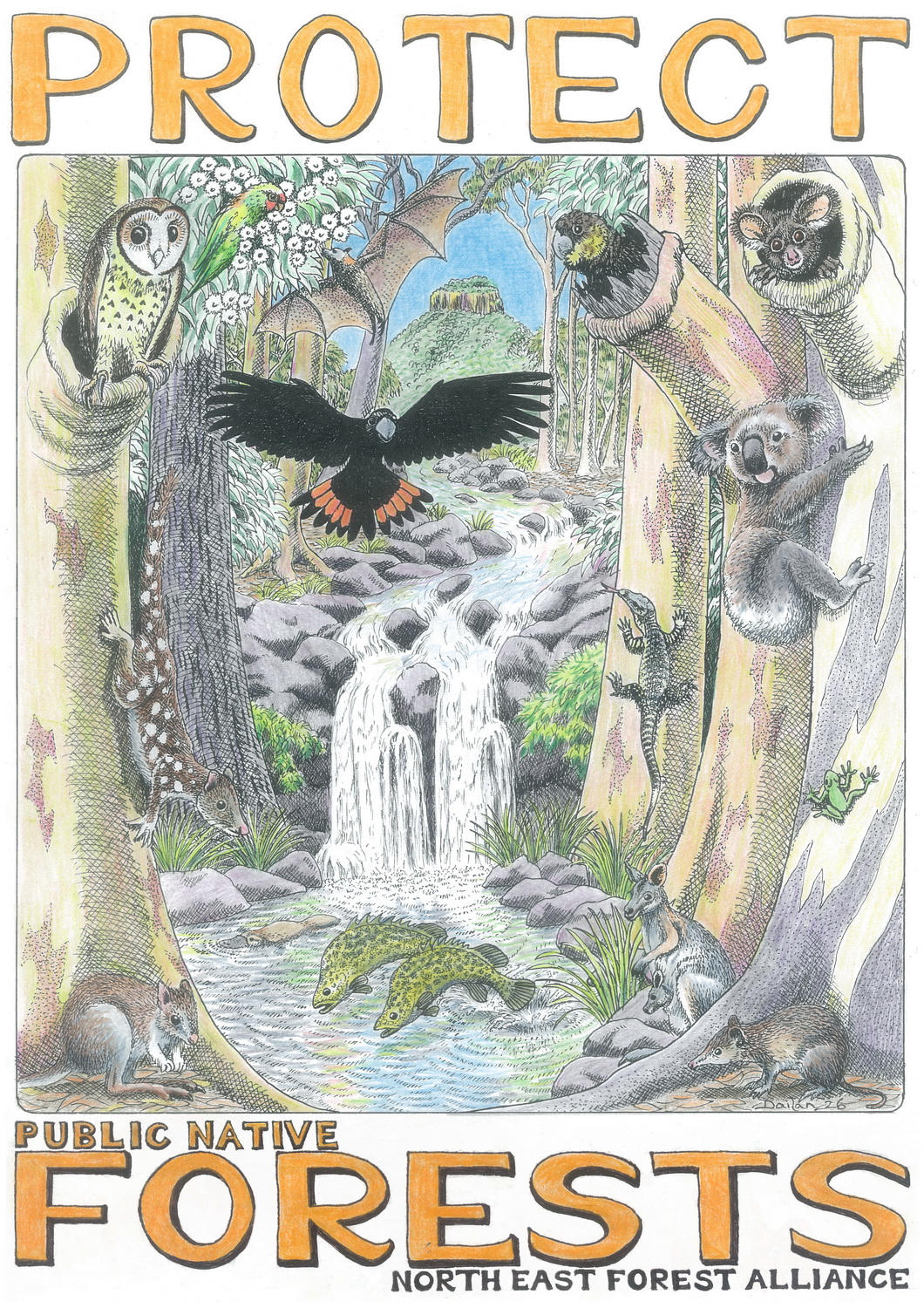
The loggers are asking for their Wood Supply Agreements (WSAs), which are due to expire in 2028, to be extended indefinitely (or for at least 10 years). They want to lock in logging to forestall any attempts to protect more forests. They argue that conservationists are getting the Great Koala National Park so they want guarantees to be able to log the rest. The choice for the NSW Government is either to protect pubic native forests or lock in their logging. So please take time to lobby the politicians (see below) and spread the message. Here is a poster you can print out in colour or black and white and spread around.
PROGRESS ON CLEARING WOODLANDS FOR ELECTRICITY
For the past 6 years, NEFA, and other groups, have been battling proposals by Verdant Earth to restart a closed coal power plant at Redbank (near Singleton) by burning 850,000 tonnes of wood per annum. This would emit 1.3 million tonnes of CO2 per annum at the plant, and much more in obtaining and processing the timber, yet they claim there are no CO2 emissions at the plant because it is "renewable" energy. Originally they wanted to obtain the timber from logging operations in native forests, though then swapped to getting most of their timber from landclearing near Cobar in central NSW. We were relieved when on 15 September 2025, the Independent Planning Commission announced they had refused Verdant Earth's latest proposal because it would require a major increase in landclearing. Though Verdant Earth are now appealing the decision. NEFA presented as an objector at the conciliation conference on 20 February 2026 and again on 17 July in the Land and Environment Court, Sydney. EDO are representing NCC in supporting the Independent Planning Commission in fighting the appeal (see NEFA Submission to the IPC on Redbank Power Station).PROTECTING NORTH EAST NSW FOR 30by30
In recognition of the world’s rapidly worsening biodiversity crisis, Commonwealth and State Governments have committed to the Global Biodiversity Framework target to protect 30% of Australia by 2030. In accordance with the National Roadmap for achieving 30by30 the governments have released maps showing priority areas for protection, identifying State Forests in north-east NSW as amongst the highest priorities in Australia for areas with exceptional biodiversity and ecosystem values and relatively low levels of protection. In addition to the Great Koala National Park, there are 580,000 ha of native State Forests in north-east NSW identified as priorities for protection, which would increase overall reservation of north-east NSW to 29.1%. Because it is public land, protecting State Forests in north-east NSW is an achievable outcome if there is the political will. It is up to the community to request their local politicians act. See Stopping logging of north-east NSW for 30by30.
----------------------------
As the next step, NEFA have started a campaign for 56,200 hectares of public native forests in the southern Richmond River valley and on Richmond Range (south of the Bruxner Highway) to be created as the Richmond River Koala Parks. This is largest stronghold of koalas in the Richmond catchment, a genetically different population from that found in the Great Koala National Park (see below). Protecting these forests will also help over 130 other threatened species and improve the health of the Richmond River.
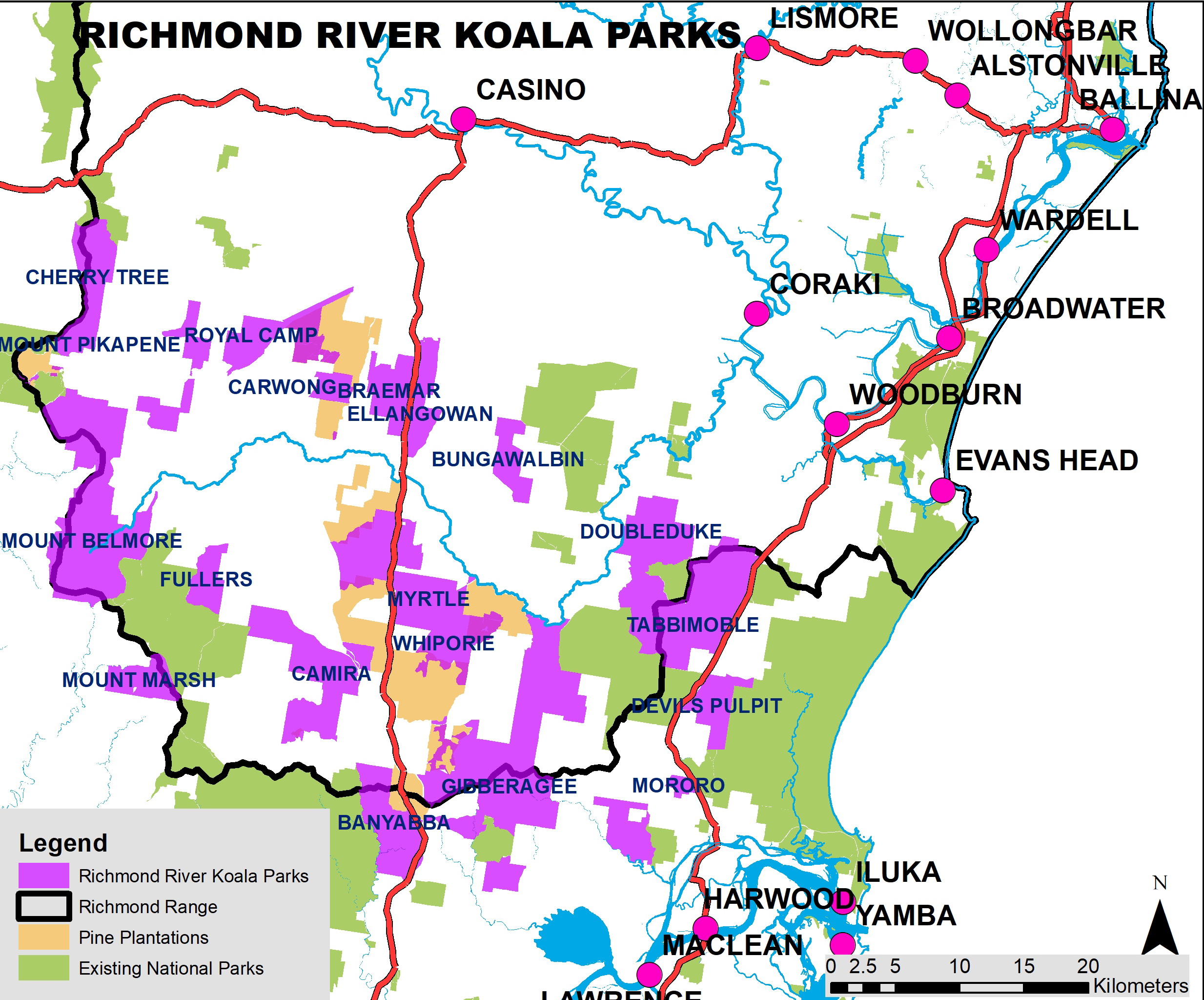
For a summary of the proposal see Richmond River Koala Parks
To join the campaign contact [email protected]
For further information visit the website
NOW IS YOUR CHANCE TO CONVINCE THE NSW GOVERNMENT TO
STOP LOGGING PUBLIC NATIVE FORESTS
Now that there is a funded pathway to protect all public native forests there is no excuse not to protect them. It is important that we take the opportunity to make representations to the Premier and key ministers, and it is also worth lobbying your local member. If your local member is from the ALP please ask to meet them.
So please take the time to add your voice to ours. A quick email will do.
See: Why logging of public native forests needs to stop. Also see our briefing note on Wood Supply Agreements.
Also see: NEFA Submission to the Independent Forestry Panel and Stopping logging of north-east NSW for 30by30
If you want to make your views known:
Contact Premier Chris Minns through his website: www.nsw.gov.au/nsw-government/premier-of-nsw/contact-premier
Environment Minister Penny Sharpe: [email protected]
Forestry Minister Tara Moriarty: [email protected]


Briefing Note: Save Koalas' Homes Briefing Note: Save Gliders' Homes
For detailed information of the travesty of Kola conservation in NSW see: NEFA's submission to NSW Koala Strategy

A victim of the 2019/20 wildfires, they are now logging the homes of the survivors
We have a hard fight ahead of us to stop logging of public native forests, though we now have hope that with your help we can get there.


Here are some resources you can use:
We have edited the fantastic, and sadly still relevant Endangered Species Roadshow film - On the Brink, with cameos from world-renowned scientists David Attenborough, David Suzuki and David Bellamy and voice overs by Jack Thompson and Olivia Newton-John. You can watch it here.
Award-winning filmmaker David Bradbury has made this moving film, Gondwana, Going, Going...Gone? Featuring clips and interviews from some of the recent forest actions from across our region. You can watch it here.
Politicians and industry often make extraordinary claims about the significance and impact of logging. We have prepared responses to Frequently Asked Questions you can read here.
